
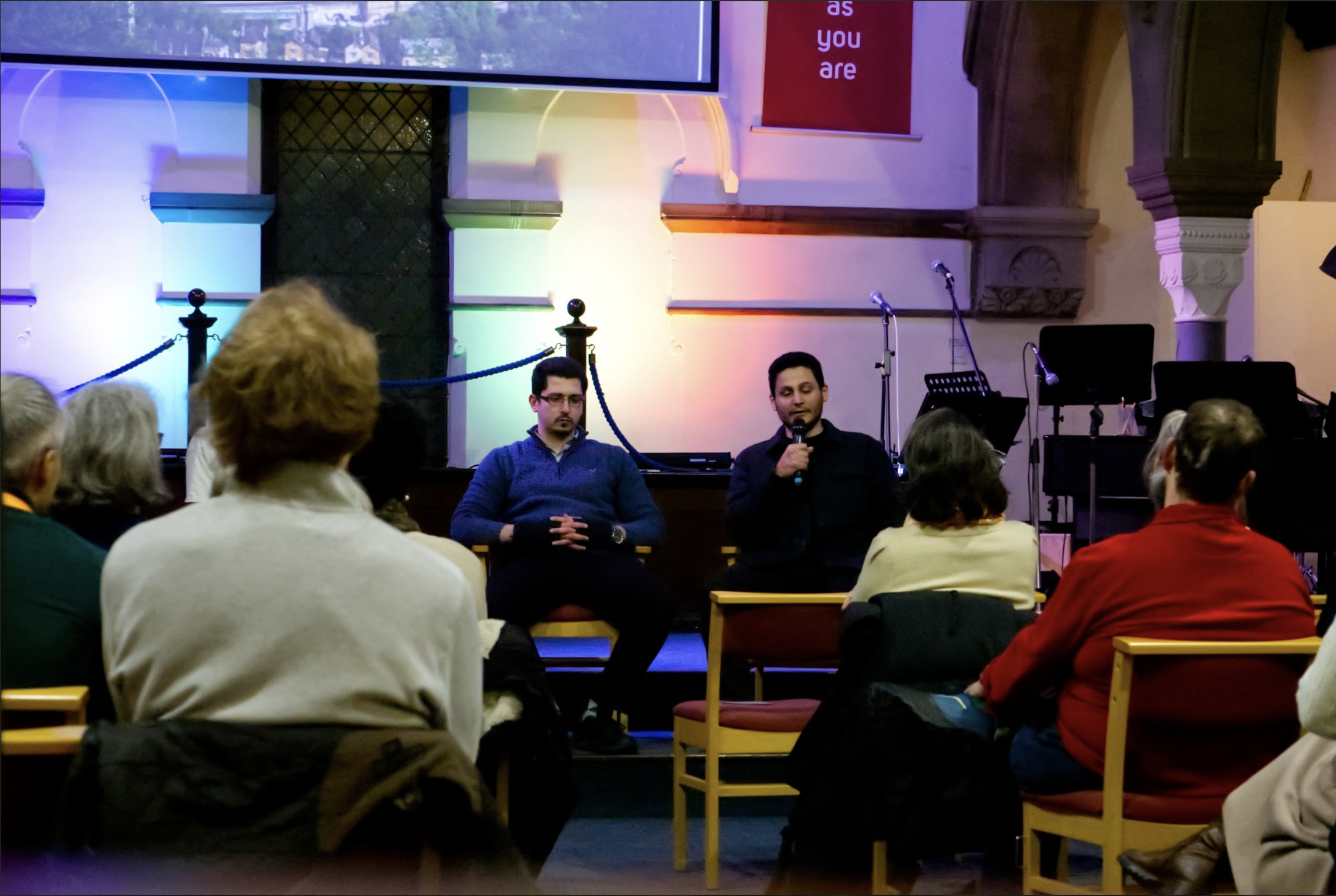
Last Thursday November 19 in Bath, more than twenty people gathered for one of the Beyond Bath series. Organised by Bath Welcomes Refugees, the discussion, Palestine: Stories of displacement, dignity and hope, sought not to debate geopolitical abstractions, but to centre the lived experiences of Palestinians navigating war, exile, and daily life under occupation.
The event brought together: Ahmed Abu Aisha, originally from Palestine and now living in the UK; Ramez Qasim, a Jordanian of Palestinian descent and volunteer at the Palestine Museum Bristol; and Peace, one of the museum’s earliest volunteers, recently returned from the West Bank after supporting the Hebron International Resource Network (HIRN).
They shared experiences of loss, resilience and hope in a way that felt human, and often missing from media headlines.
Creating space for understanding
The evening opened with a welcome from Andrea Dos Anjos, a volunteer with Bath Welcomes Refugees. She reminded the audience that Beyond Bath exists to “move beyond headlines, beyond fear, and towards empathy, context, and humanity.”
She framed the event as an invitation, not to perfect knowledge, but to collective learning. “What we need is the willingness to stay in the conversation. To unlearn some things, and learn new things.” she said.
That spirit of openness set the tone for the discussion that followed.
“We are not numbers. We are stories”
For Ahmed, the war in Gaza is not distant history, it is an ongoing, personal catastrophe. His voice carried both exhaustion and clarity as he described October 7th as a “turning point” that shattered the last remaining fragments of normal life.
“We lost everything,” he said. “Ninety percent of the buildings [in Gaza] have been destroyed. We had to drink polluted water and we desperately tried to get aid, we were left with no option and in such a situation you lose the sense of connection among the family. No medical treatment was available and amputations were the go-to procedures.”
Despite what the media say about a ceasefire, Ahmed stressed: “There is no ceasefire. My uncle’s house was bombed today and my cousin was hurt.” Aid is arriving, but often in the form of “secondary aid”—coffee, for instance—instead of essentials such as flour, baby formula, or food.
Before the war, he recalled walking every Saturday on the beach in Gaza with his mother. Now two memories dominate his mind: discovering, with a month’s delay due to internet blackouts, that members of his family had been killed, and the moment he was forced to leave his family behind.
“I’m not lucky to have made it out. I would be lucky if all my family were out”, he said.
He spoke about leaving home under evacuation orders allowing just ten minutes to gather belongings, often less. “Leaving home means leaving a part of you,” he said. “You go to live in a tent. No privacy, no dignity.”
Today, living in the UK, Ahmed continues to carry survivor’s guilt. But he also holds hope: “I want to see my family again, my neighbourhood, my house. I want my country to be free, where Muslims, Christians and Jews live together in peace.”
Life under occupation: “Simple things become impossible”
Ramez, whose family comes from the West Bank, reminded the audience that Gaza and the West Bank, though geographically separated, remain part of the same context.
In the village of Silat Al-Daher, he said, families place barbed wire on their windows to protect themselves from attacks by Israeli settlers. He described how the West Bank is divided into Areas A, B and C, with Area C under full Israeli control, shaping every aspect of daily life, from movement to building permits.
“When my cousins come from Palestine to Jordan,” he added, “the first thing they want to do is go to the beach and drive around. Because living under occupation doesn’t allow those simple things.”
He echoed Ahmed’s reflection on representation: “Palestinians are deeply political. We hold many perspectives. But in the media, we’re portrayed as numbers.”
Ramez envisions a future “where all people from the river to the sea have the same rights.”
He urged those in the UK to learn, share knowledge, and support organisations such as Medical Aid for Palestine and Zaytoun.
Witnessing the West Bank: “Steadfastness defines them”
Peace, who recently returned from volunteering in the West Bank, painted a stark picture of worsening conditions in the West Bank, growing settler violence, economic collapse, and a climate in which authorities act with impunity.
Yet what struck him most was the determination of ordinary Palestinians to continue living with purpose despite the hardships. That determination is captured by the word sumud, meaning steadfastness.
“People carry on with their plans no matter what,” he said. “Demolition orders, killings, they still continue. That’s sumud.”
He also emphasised the warmth of Palestinian hospitality. “People would tell me: ‘We don’t hate the Jews. We just want to be left alone.’”
Peace spoke about the role of the Palestine Museum Bristol as a “safe place for Palestinians and supporters,” adding that privilege also shapes solidarity: “Ramez isn’t allowed to travel to Palestine, while I, as a white British guy, can. This shows how broken the system is. That’s why I know I have a responsibility to be a good ambassador.”
His hope is simple yet profound: that one day people will be able to travel freely “from the West Bank to Gaza to Jerusalem without applying for a permit.”
Solidarity From the UK: Action begins with listening
Throughout the discussion, a single message echoed: solidarity must be meaningful, informed, and grounded in human connection.
Ahmed urged the audience to believe in the power of collective action: “This can change politicians’ perspectives.”
Ramez emphasised knowledge-sharing, while Peace highlighted the importance of meeting like-minded people.
Andrea reminded everyone that solidarity often begins locally, with a conversation, a book group, a donation, or an invitation to listen. The main invitation was turning emotion into action.
“It’s in these small acts,” she said, “that we shift how we understand migration and the refugees’ experiences, one conversation at a time.”
Some resources
Book The Hundred Years’ War on Palestine by Rashid Khalidi.
Book The Eyes of Gaza: A Diary of Resilience by Plestia Alaqad.
Back to Blog